Showing posts with label Lisa's Picks. Show all posts

Monday, 20 November 2017

The Inexplicable Logic of My Life

by Benjamin Alire Saenz


The opening lines of Leo Tolstoy's Anna Karenina go something like this: Happy families are all alike, but unhappy families are unhappy in their own way.  Salvador Silva and his adoptive father, Vicente, seem like a stereotypical happy family.  Salvador is a fairly content and well-adjusted teenager, about to start his final year of high school.  He has college applications waiting to fill out.  But lurking beneath the surface are the unhappy moments that afflict all families, each with their own unique pattern.

As much as Salvador loves and adores his father, he can't help but wonder about his biological father, and feels incredibly guilty for doing so.  Vicente's mother -- Salvador's beloved Mima --  is ill, which upends Salvador's previously well-ordered life.  But at least Salvador's life is more-or-less on an even keel, thanks to Vicente's patient and loving parenting style.  His best friend, Samatha, has a difficult relationship with her mother and as for her father, he might as well be a stranger on the street.  Salvador's friend, Fito, has a nonexistent relationship with his mother, because according to Fito, she abandoned him for the siren song of addiction, and his father left El Paso for California to look for work, and Fito hasn't heard from him since.

Finding a place where they can find a level of balance that approaches happiness is what drives this novel.  It's more of a character study than one with an easily described plot.  Saenz shows his readers how each character reacts to a given situation, such as when Fito's mother throws him out of the house, or Salvador punches a classmate for insulting Vicente.  The threads that bind this novel together are the ties of friends and family -- both the families they're born into and the families they create.  Family seems to be an ongoing theme for Saenz, from his earlier work He Forgot to Say Goodbye to his award-winning Aristotle and Dante Discover the Secrets of the Universe.  And in The Inexplicable Logic of My Life, it looms over the whole book.

Another compelling theme of the novel is the nature vs. nurture argument, something Salvador grapples with on a daily basis, as he tries to answer the question of whether nature or nurture has more power over who Salvador will be when he grows up.  Fito struggles with it as well, albeit in a quieter way.

Saenz is capable of some truly gorgeous writing that lifts your heart into your throat, which at times borders on poetry (even though it's not technically poetry).  Like this quote: "...she burned her hand when some hot oil splattered.  The F word went flying through the kitchen and landed in the living room, where it hit my dad right in the heart."  Saenz is a master of figurative language.

Most of the novel takes place within Salvador's head, as his internal monologues and observations of what goes on around him.  Due to the subject matter, there's a lot of poignancy to Salvador's thoughts, including one about the different types of silences between people or ruminations on love.  I'll admit to needing more than one tissue.

There is a bit of salty language in the book.  Salvador even makes note of the fact that Samantha has had a love affair with the F word, as she chastises him for his swearing.  It never feels gratuitous and absolutely feels organic in the mouths and minds of Salvador, Samantha, and Fito.

Other books like The Inexplicable Logic of My Life are: The Absolutely True Diary of a Part-Time Indian by Sherman Alexie, the new Ms. Marvel series of graphic novels, featuring Kamala Khan, Jenny Han's To All the Boys I've Loved Before, and Rainbow Rowell's Eleanor and Park.  They all have themes of family dynamics running through them.


Friday, 1 September 2017

Book of the Month: September: Scythe

by Neal Shusterman

Imagine a world where humanity has conquered death.  There's no more disease, hunger, poverty, ageing, or death by accident.  Sounds really neat, right?

Until you consider there's also no pain.  Or joy.  Or any intense feelings.  People sort of drift along in life, "turning the corner" (resetting to a younger physical age) every so often, marrying and remarrying.  Just living their lives.  The only possible wrinkle in someone's life is when a Scythe drops by.

If a Scythe shows up in your home, school, or office, it usually means someone is going to die. You, see,  a Scythe is tasked with "gleaning" -- killing -- people, in order to keep the population under control.

Every so often, a Scythe takes on an apprentice, in order to teach them the ways of being a Scythe and how to glean according to their moral codes.  One just doesn't take a life indiscriminately.  There's a method to the madness.  Honorable Scythe Faraday raises more than a few eyebrows when he takes in two apprentices.  Usually a Scythe only takes one apprentice.  For the next year, Citra Terranova and Rowan Damisch will endure training in the physically and mentally demanding art, science, and philosophy of ending another person's life.   Whichever one of the two succeeds in passing a test at the end of the year will become a new Scythe.  The other will go home.

At least that's the way it's supposed to work.  Until Scythe Goddard  proposes a resolution at one of the Scythes' conclaves that the successful apprentice must glean the unsuccessful one.  This sets the rest of the book careening toward it's suspenseful conclusion.

Neal Shusterman never ceases to impress me with his world building.  At first glance, this is a perfect world, until Shusterman reveals, the levels of corruption roiling under the perfect surface. Everything Shusterman creates -- from nanites that heal every injury and cure diseases to the Thunderhead, which has evolved from the Cloud into a benign, omniscient presence that governs society -- are just within the realm of possible, so you aren't grappling with the science of science fiction and are able to dive into the knotty philosophical questions that come with being a Scythe: is there room for compassion; why can't a Scythe feel that being a Scythe is a calling; and is it possible to enjoy one's job as a Scythe?

Even though the laws of Scythedom are presented as a absolute, the laws and rules of Scythes, like everything, are open to interpretation, which is where a lot of the conflict arises.  And to throw another wrench into the plot, Scythes aren't subject to the laws that govern the rest of society and only live by ten ironclad commandments.  They even live outside the realm of the all-knowing and all-seeing Thunderhead.

The book is heavy on intrigue, but (thankfully!) light on romance.  Which makes sense, because Scythes, rather like Jedi, aren't supposed to have emotional attachments to other people.

Structurally, the book goes back and forth between  Citra, Rowan, Faraday, Scythe Curie, and other characters.  Each chapter opens with an excerpt from the diary of a Scythe, usually Scythe Curie, known as the Grand Dame of Death.  It's fascinating to see the different points-of-view of Scythdom and how different Scythes interpret their moral codes.

This book drew me in so subtly and cleverly, that I didn't even realize I hadn't been able to put it down until I finished it.

Scythe so impressed the Printz committee, that they gave it an honor, even though their habit is to not award the first book in a series.  It more than deserves its 2017 Printz Honor.

If you're looking for something that draws you in and doesn't let go, this is a book for you.

Scythe is the first of Shusterman's Arc of the Scythe series.

If you want to explore other books by Shusterman, read his National Book Award winning Challenger Deep, or the Unwind series.

Thursday, 1 June 2017

Born a Crime: Stories From a South African Childhood

by Trevor Noah

You probably know Trevor Noah from Comedy Central's The Daily Show.  Trevor was a surprise pick to replace the indomitable Jon Stewart, but the South African comedian has slowly come into his own and as you read his new memoir, Born a Crime: Stories From a South African Childhood, you might start to think perhaps Jon Stewart had a very good reason to pick Trevor as his successor.

Noah's story doesn't begin with his birth.  It goes back much further than that, when the white South African government imposed the system known as apartheid on its inhabitants, hitting black South Africans the hardest with repercussions that continue to this day. Noah's mother, Patricia, rebelled against apartheid as much as possible, becoming a secretary and then making the momentous decision to have a child.  But not just with anyone.  Patricia turned to a friend, Robert, who also just happened to be a white Swiss expat.  In South Africa at that time, it was not only illegal for Trevor's parents to have a sexual relationship, it was punishable by several years in prison.  Trevor's very existence was, in fact, evidence of a crime.

Trevor describes his childhood in a series of eighteen essays, that cover everything from his mother's insistence they attend three different churches on Sundays to his laughably inept attempts to woo girls in high school to the difficult and often turbulent relationship Trevor had with his abusive stepfather.  The essays are by turns funny, moving, and heartbreaking.  Throughout the essays, Trevor is careful to not only describe the effect apartheid had on his family and other black South Africans, but to multi-racial people labeled as "Colored,"  Trevor also points out the often arbitrary rules of apartheid that sometimes popped up seemingly overnight, with no other purpose than to further divide South Africa's black and Colored peoples.  He even devotes several pages to how apartheid affected his father and other whites who disagreed with apartheid.

If Trevor is the star of the show, his mother, Patricia, often steals the spotlight as his determined supporting actress.  If nothing else in the world, Patricia is often the voice of Trevor's conscience and the force nudging him to reach for something better.

The book is an easy read in terms of readability.  Trevor's voice shines through the page, and he makes it sound like he's sitting at a table in a coffee shop regaling his friends with the most meaningful moments of his childhood.  His language does get a bit salty at times, but it never comes off as gratuitous.  Another thing to keep in mind is the book doesn't move in a straight line from Trevor's birth to his early 20s.  I had a really hard time putting it down.  If you like memoirs, this is definitely one to read.

Monday, 20 March 2017

Exit, Pursued by a Bear

by E. K. Johnston

Exit, Pursued by a Bear is a worthy successor to Laurie Halse Anderson's seminal novel Speak.  In Speak, Melinda Sordino was so traumatised by her assault that she was unable to even say the words "I was raped," to herself, much less out loud for months afterwards.  Hermione Winters, the protagonist of Exit, Pursued by a Bear, is everything Melinda was not: popular, confident, unwilling to cower in the aftermath of her rape, with the bonus of super-supportive parents and a steadfast best friend.

Hermione is the co-captain of the award-winning cheerleading team at Palermo Heights High School in the small town of Palermo Heights, Ontario.  On the first night of an annual summer cheer camp, every school talks about their inner collective demons: fear of heights, plagues of self-doubt.  Hermione, though, describes PHHS as a cursed school where, "every single class... since 2006 has lost a student to a drunk driver... [and] every year one of the girls in PHHS gets pregnant."  The cheerleading squad's challenge is to break the curse.  Hermione's class may have lost a student years ago to a drunk driver, but they are determined that there will not be a pregnant girl at PHHS this year.

The cheerleading team is no laughing matter, and in fact they are the pride of Palermo Heights.  In Palermo Heights, the sports teams play second fiddle to the cheerleaders. PHHS's cheerleading team is also unusually tightly-knit, which is a factor in their ongoing success.  This camaraderie is threatened during cheer camp.  One minute Hermione is dancing at the end-of-camp dance, and the next thing she remembers is waking up in a hospital, where her best friend, Polly, informs Hermione she's been raped.

Hermione refuses to let one single event define her, but it proves difficult in a small town with a small high school.  The whispers, stares, and rumours follow Hermione as she tries to move on from the rape, enlisting the help of once-a-week sessions with a psychologist, and throwing herself back into cheerleading.

Johnston handles several sensitive issues -- rape, pregnancy, abortion, sexuality --  in Hermione's matter-of-fact voice.  It serves to put things into perspective.  Yes, Hermione's rape is traumatic, and she experiences flashbacks, often at inopportune times, but to Hermione the actual event matters less than how she decides to handle it.  I think that is what makes this book stand out in a crowded YA shelf: Hermione decides who is going to tell her story.  It's on her terms and no one else's.  It also passes the infamous "Bechdel test," in which two women discuss anything other than a boy.

If the title rings a bell, congratulations!  You are officially a Shakespeare nerd.  "Exit, pursued by a bear..." is one of the more bewildering stage directions in Shakespeare, from his play A Winter's Tale.  To this day nobody knows if Shakespeare intended to use a real bear or an actor in a bear costume.  The novel, though, is much less circumspect.  The bear that pursues Hermione are the myriad slings and arrows from the aftermath of the rape.  The novel is a cleverly drawn parallel between Shakespeare's play of a falsely accused queen named Hermione.  So, Exit, Pursued by a Bear, is in fact, a Winters' tale, because it is the tale of Hermione Winters.  In the play, King Leontes accuses Queen Hermione of having an affair.  In the novel, Hermione's boyfriend Leo, doesn't really believe she was raped.  The play has a character called Polixenes who proclaims Hermione's innocence, and the novel has Hermione's bestie Polly, who will defend Hermione until she no longer has breath.

If you enjoy books with strong female leads, and read a realistic story where girls can talk about more than their respective love lives, you'll enjoy this book.  I know I did.

For read-alikes, try Forgive Me, Leonard Peacock by Matthew Quick; The Perks of Being a Wallflower by Stephen Chbosky, and of course, Speak by Laurie Halse Anderson.


Monday, 2 January 2017

Book of the Month: January -- Saving Red

by Sonya Sones

Fourteen-year-old Molly has to finish her volunteer community service hours.  Now.  Really.  The assignment is due tomorrow morning.  Which is how she finds herself in the company of Feather and Eden, doing Santa Monica's annual count of homeless people.  When Molly finds a teenage girl in the grip of a nightmare sleeping on a park bench, she can't forget the girl with the blazing red hair.  After a couple of chance encounters with Red, Molly vows to reunite Red with her family for Christmas.

It turns out to be a lot more difficult than Molly imagines.

Molly's dealing with her own problems at home.  Something tragic happened, but Molly won't say it aloud, and neither will her parents.  So her mother copes by smoking pot and buying one of everything from the Home Shopping Network, and her father deals with it all by working so much he's hardly ever home.  Molly's so traumatized by this event, that she's prone to panic attacks, and has a preternaturally wise service dog named Pixel.  

And Red?

Red hears voices.  Sometimes they tell her to do helpful things.  Other times, their instructions are destructive to both Red and her family.  Plus, Red isn't the slightest bit interested in getting help.

Throw in Cristo, the boy she meets on the Ferris wheel at the Pacific Park pier, and Molly has quite the jam-packed winter break from school.

Technically, this is a "verse novel," or a novel written entirely in poetry.  But this isn't you're grandmother's poetry, or even your mother's poetry.  Sones writes stunning, moving inner monologues, where the placement of a single word can pack more of a visceral emotional punch than pages of text.  You also still get the experience of reading a novel, but without the edge-to-edge text of a traditional novel.  Don't let the size of the book intimidate you!  It's a quick read.  I found myself eagerly turning the page to find out what happened next.  Sones also doesn't trivialize mental illness.  She delves into the impact it can have on the person struggling with an illness and their families.  Even though Sones manages to neatly wrap up the novel at the end, it's obvious that there are still lots of unanswered questions.

Sones also wrote What My Mother Doesn't Know and What My Girlfriend Doesn't Know.  Other verse novels you might want to try are Inside Out & Back Again by Thanhhai Lai or the Crank series by Ellen Hopkins.

There are several novels that also deal with mental illness, but you might want to read Marcelo in the Real World by Francisco X. Stork or Challenger Deep by Neal Shusterman.  


Monday, 3 October 2016

Symphony for the City of the Dead: Dmitri Shostakovich and the Siege of Leningrad

https://yourlibrary.bibliocommons.com/item/show/1199809101_symphony_for_the_city_of_the_dead
by M.T. Anderson

 Truth is stranger than fiction sometimes.  Sometimes, the truth is so bizarre, so out in left field, so deliciously weird that even Muldar and Scully would have to investigate.

Our tale begins with a spy-worthy journey as a mysterious microfilm makes its way from Soviet Russia to Tehran, then on to Cairo, through northern Africa, where it crossed the Atlantic Ocean, landing in Recife, Brazil, where it was picked up by a U.S. Navy plane and flown to Florida, finally landing in Washington, D.C.  What is on this mysterious microfilm?  Battle plans?  Spy reports?  Wait, what?  A symphony?  All that for a symphony? You bet!

The following pages present a multi-layered biography, not just of the composer Dmitri Shostakovich, but also of the establishment of the Soviet Union and its often bloody and terrifying history under Joseph Stalin.  A dual biography is important for context here.  It's impossible to understand Shostakovich and his works unless you understand the circumstances under which he composed.  For this particular book, M.T. Anderson uses Shostakovich's Seventh Symphony -- the Leningrad Symphony -- as the lens through which he views not only Shostakovich, but the Soviet Union.  One of the most remarkable things about the Seventh Symphony is that Shostakovich composed most of it while living in Leningrad during the brutal Nazi siege (September 1941-January 1944) in World War II.  The Seventh Symphony became synonymous with the Soviet war effort during World War II, and was key in gaining material support from Western allies.  The symphony humanized the Soviets to Western audiences and was often played as part of fundraising efforts on behalf of Soviet civilians.

Anderson presents a well-researched book about one of the most well-known 20th century composers, who wrote music under unimaginable circumstances (the Russian Revolution, the purges under Stalin, the repudiation of Shostakovich by people he considered friends). He also refuses to condescend to his intended audience, and never sugarcoats the torture under the Stalin regime or the privations in Leningrad under the siege.  Anderson doesn't dwell on it, either, but he offers more than enough detail to get the point across without gratuitous lingering over some of more gruesome aspects. Anderson is also mindful of his subject.  The Soviet Union was not a place where one could necessarily freely exchange ideas.  Every so often, Anderson reminds his readers that quotes attributed to Shostakovich might genuinely be Shostakovich's ideas, but there is a good chance Shostakovich spoke under duress.  It also wasn't uncommon for the Soviet government to allow artists to travel outside the Soviet Union, but keep their family home as "insurance" that the artist in question would not only toe the Communist party line, but return home.

Anderson provides several photographs of Shostakovich, Leningrad during the siege, and production photos from the Soviet performing arts scene of the 1920s.  He also helpfully provides maps that outline the Nazi siege of Leningrad, delineating German and Soviet held territory.  Anderson also includes an extensive bibliography of works he consulted while he wrote the book.

This book would be a great resource if you're in Social Studies 11/12, and would like a different perspective of World War II.  To be honest (and I was a history teacher for many years before I earned my library degree), the Soviet side of things is somewhat forgotten in the larger narrative of World War II.  It would be also a good idea to track down some of Shostakovich's recordings and listen to them after you've read the book.  Google "Shostakovich Seventh Symphony," and you ought to find several recordings on YouTube.  You don't have to watch the video, just listen.  Shostakovich's symphonies really are as Anderson describes them: film scores without the film.  After reading Symphony for the City of the Dead, you don't really need a film to appreciate Shostakovich's music.

M. T. Anderson is the author of the award-winning books Feed and The Astonishing Life of Octavian Nothing.

*On a side note, if you look on a map of Russia today, you won't find a city called Leningrad.  You will find St. Petersburg, though;  Anderson traces how St. Petersburg became Petrograd, then Leningrad under Soviet rule.  It wasn't unusual for cities to have their names changed under Soviet rule, and they sometimes changed almost overnight when a new Party leader came to power.

Monday, 18 July 2016

The Shadow Hero

https://yourlibrary.bibliocommons.com/item/show/1184826101_the_shadow_hero
by Gene Luen Yang, illustrated by Sonny Liew

Hank Chu goes about his life, like most young men in Chinatown.  He spends his days working in his family's store and his spare time playing mahjong with his father and his father's friends.  It's a quiet life, and Hank enjoys it very much.  His world turns a little upside down when his mother is rescued during a bank robbery by a superhero, The Anchor of Justice.  Mrs. Chu throws herself into turning Hank into a homegrown superhero, subjecting him to everything from odd medicines to toxic sludge; sewing a costume; and driving him around Chinatown at night to try and find crimes in progress.  Let's just say it doesn't go well.  Hank is initially resistant to his mother's actions, but when his father is killed, all bets are off, and Hank is out to avenge his father's killer, with a little help from the Turtle, one of the guardian spirits of China.

The Shadow Hero is an origin story for a short-lived superhero comic series from the 1930s written by Chu Hing, called the Green Turtle, who is said to have been the first Asian superhero.  It uses a lot of the stereotypical superhero tropes (parent violently dying, secret identity, teenaged protagonist), but adroitly avoids some of the others, like women in distress or the protagonist having lots of nifty tools and toys. Hank also lacks the seemingly bottomless bank account that goes with the supply of cool toys.  (Yeah, I'm looking at you, Batman and Iron Man!)  Hank manages to fight crimes based on his own wits, strength, and intelligence, which makes a refreshing change from otherwordly powers and gadgets.  Another thing I really liked was that Hank never contemplates killing his enemies and tries to avoid violence at all if he can.

Yang writes wonderfully complex characters.  The character that leads a quiet life turns out to have been a troublemaker in his younger days.  Do stereotypes exist in his comics?  Yes, but they don't stay stereotypes for long.  Circumstances change his characters, sometimes for better, sometimes not.  But nobody stays static in Yang's world for very long.

Sonny Liew's drawings evoke vintage comic books, and he does a great job differentiating between events in the past and present. He even uses the classic comic elements of onomatopoeic sound effects ("bang," "pow," etc.).  He manages to draw the characters so that they are readily distinct from one another.


Gene Luen Yang is the award-winning author of American Born Chinese, Boxers & Saints, and Level Up.  He also wrote several Avatar: The Last Airbender comics. 

Monday, 15 February 2016

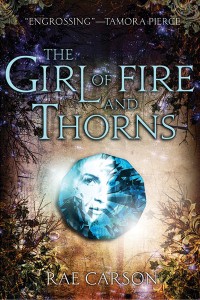
The Girl of Fire and Thorns

https://yourlibrary.bibliocommons.com/item/show/1163461101_the_girl_of_fire_and_thorns
Rae Carson

Lucero-Elisa de Riqueza, the younger princess of the kingdom of Orovalle, is wed in an arranged marriage to King Alejandro de Vega, of the neighbouring country of Joya d'Arena.  Joya d'Arena is embroiled in a war with another country, Invierene, and their situation is precarious.  Elisa has been marked by God with a blue gemstone embedded in her navel since birth to do something special, although no one knows what.  Yet.  All this and Elisa is only sixteen years old.

After Elisa arrives at the palace in Joya d'Arena, she's kidnapped by a group of rebels, and dragged across the desert. Once they arrive at the rebel village, Elisa embraces their cause, and uncovers a treacherous plot against King Alejandro.  Can she save Joya d'Arena in time?

One of the things I enjoyed the most about The Girl of Fire and Thorns was that Elisa wasn't a typical YA heroine.  She's not considered particularly beautiful, and she's also quite overweight.  Fat, in Elisa's words.  She uses food as a coping mechanism until she no longer has that option and has to figure out how to deal with any problems that arise using her own wits and intelligence.  Another thing that sets this medieval-themed fantasy novel apart is that the marriage is not something Elisa looks forward to.  She's terrified, the people in Joya d'Arena look at her as an outsider, her husband is not the least bit interested in her, and most people treat her like the child she still is.  Carson presents a rather realistic view of what it must have felt like to end up in a dynastic marriage.

There are lots of Spanish-language influences in the book and the religion of Elisa doesn't feel as if it only resides in an alien planet.  The familiar feel of the language and religion reader help ease you into the novel and quickly establishes the setting.  It think it's important to say here that you shouldn't let the heavy presence of the world's religion drive you away from the book.  It's absolutely  integral to the plot and Elisa as a character.

The Girl of Fire and Thorns is a great action-packed read with a relateable heroine, who repeatedly falls down, makes mistakes, and picks herself back up, because it's the only thing she can do. 

There are two more books in the series: The Crown of Embers and The Bitter Kingdom.